
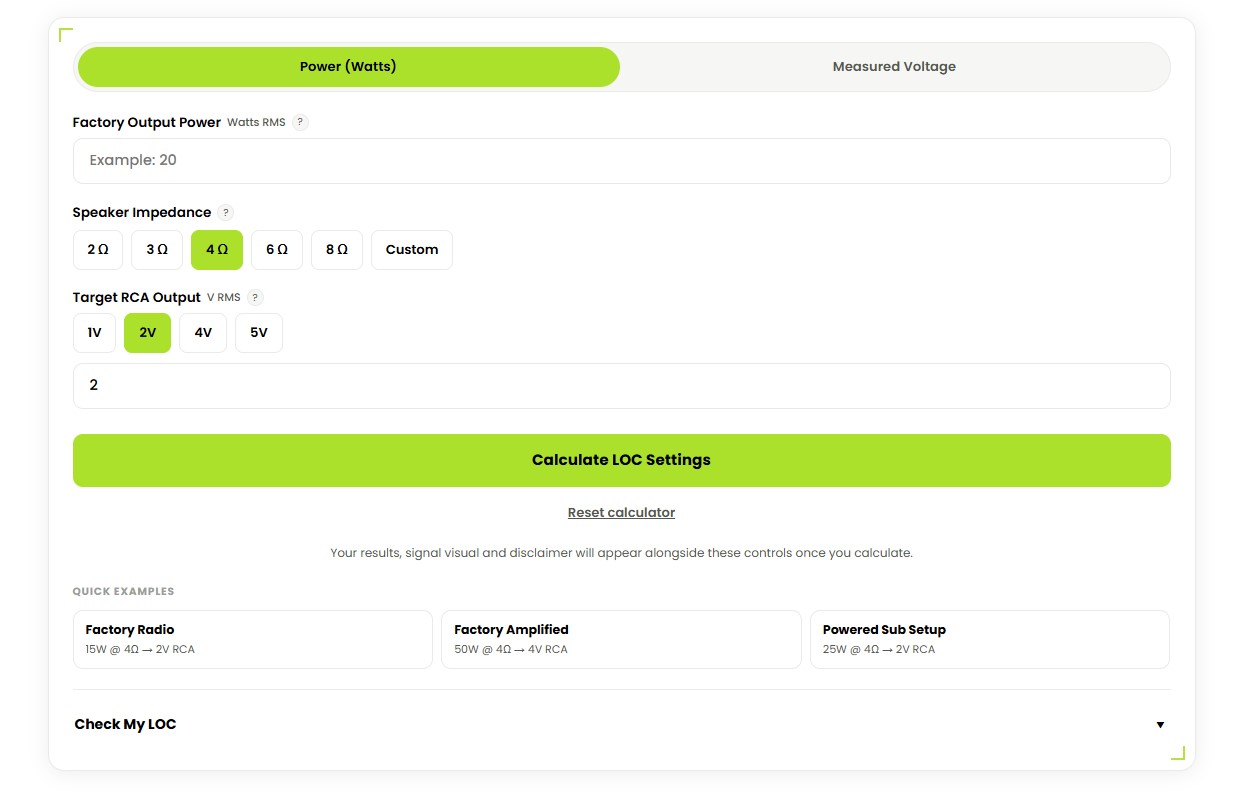
Enter approximate RMS output per channel, not total system power.
Enter a power value greater than 0.
Use the impedance of the speaker circuit being tapped for the LOC.
Enter an impedance greater than 0.
Enter the RCA signal level you want to feed into your amplifier.
Enter a target voltage greater than 0.
Enter a measured voltage greater than 0.
Impedance is only needed here if you also want an estimated speaker-output power.
Enter an impedance greater than 0.
Enter a target voltage greater than 0.
Your results, signal visual and disclaimer will appear alongside these controls once you calculate.
Quick Examples
i Awaiting calculation
i --
Calculated values are estimates based on the information entered. Actual factory audio output and LOC capabilities vary by vehicle, stereo, amplifier and converter. Always verify the specifications of your equipment before installation.
The calculator determines the level of voltage produced by the factory stereo system in terms of the speaker-level voltage and transforms it to the targeted RCA voltage, which provides the reduction in voltage, the attenuation ratio, and the dB attenuation. This is intended for those who are installing the amplifier or subwoofer to the factory audio system. The factory output should be inserted in watts RMS with speaker impedance or AC voltage.
The term line output converter refers to a small electronic component which reduces voltage of an audio signal from the speaker level to RCA or preamp level. Most factory car stereo systems connect directly to the speakers while many after-market amplifiers and other audio processors require a line level RCA connection.
This component is placed between the factory wiring to speakers and the equipment requiring RCA connection. This is how the voltage gets reduced without affecting the audio signal. The operation of this component varies in different cars so it is important to check the results with the equipment used.
The calculator takes two initial points. You can either use the rated output of your factory amp in watts RMS, with respect to speaker impedance, or, if you have done measurements of the signal level at speaker terminals using a multimeter, enter the AC voltage instead.
The next thing you will need to enter is the desired output voltage of the RCA cable, which is calculated from the rated output of your LOC or the input sensitivity of the amplifier.
The calculator computes Voltage as the square root of (Power × Impedance), when working with power RMS and impedance. For instance, 20 watts RMS into a 4 ohm speaker is equal to around 8.94 volts RMS. Since actual values can be affected by loudness and equalization settings, the measurement of voltage is generally more accurate than power RMS.
Voltage Ratio is computed as Input Voltage divided by Target Voltage. Decibel Attenuation is then 20 × log10(Input Voltage ÷ Target RCA Voltage).
For our hypothetical scenario, an 8.94 volts speaker level input signal attenuated to a 2 volt target RCA voltage yields a voltage ratio of around 4.47:1, which requires 13.0 dB of attenuation. Simply put, the LOC needs to attenuate the signal to roughly one-fourth of its value without distortion.
The line output converter becomes necessary when there are no RCA preamp outputs provided by the factory-installed stereo system which happens to be in case of head units that are capable of running speakers alone. It is necessary when a new amplifier, powered subwoofer, or audio processor is being installed because these devices require an input from the car audio system in the form of RCA connector.
Installing a subwoofer in a factory installation is among the top reasons why individuals consider getting an LOC for subwoofer usage. The majority of the subwoofer amplifiers and powered subwoofer boxes operate through RCA inputs. Since factory audio systems typically produce speaker-level output, the LOC serves as the intermediary that enables the system to power a new subwoofer amplifier. It pays to calculate the output in advance so that it falls within the acceptable input of the amplifier.
It is important due to the fact that it dictates how much attenuation the LOC should have and how well the signal will be compatible with the sensitivity of the receiver. However, there is no single RCA voltage that is right, as different amplifiers and processors require different sensitivity. Compare the result provided by the calculator with the output specification of your LOC, the sensitivity of the amplifier and the instructions provided by the producer. The calculator calculates the theoretical relation between two signals – not their physical compatibility.
It should be understood that the results of the calculations provided here are mathematical estimations on the basis of the information you provide. They do not represent any real measurements that could be made in your vehicle. The factory amplifiers are not always stable in terms of the voltage that they generate; this may vary with the frequency of the signal, equalization, or the volume level; some systems use limiting or differential (non-grounded) outputs. The speaker impedance may also vary slightly from its rated value.
Running your numbers before buying an LOC helps you choose a converter with an appropriate voltage range. For more on how these devices work in real vehicles, see Crutchfield’s guide to line output converters. For other measurement conversions, CalcVersa’s Unit Converter can help, and the Audio Converter is there if you need to convert digital audio file formats.
The signal from a source such as a factory stereo at the speaker level is transformed to have a lower voltage signal and produce a line-level RCA signal for RCA-input devices.
This will depend on the input types supported by the amplifier. In case the amplifier supports RCA input and the device source does not have RCA output ports, then an LOC becomes necessary. Amplifiers with internal speaker level input ports do not require an LOC.
Yes. This is among the most common applications of the LOC, considering that most subwoofer amplifiers and powered boxes support RCA inputs instead of speaker inputs.
Speaker level signal is a high-voltage signal capable of driving speakers directly, whereas the RCA level or line-level signal is low voltage signal designed for the input port of an amplifier.
Use Voltage = the square root of (Power x Impedance). For instance, 20 watts RMS fed into a 4-ohms loudspeaker gives an approximate RMS voltage of 8.94 volts.
There is no one correct value to match, since that is dependent on the sensitivity of the receiver or amplifier and the specifications of the LOC in use. One has to consult the manuals of the equipment in question and compare them with the values obtained from the calculator.
Its purpose is to convert the signal level correctly, and not to enhance the audio. Proper matching of voltage and avoiding clipping of the signal helps maintain sound quality, but the LOC itself is not an audio enhancer.
Yes, most of the time. If the amplifier has built-in speaker-level inputs, one may feed the original factory-level speaker signal without using the LOC.
CalcVersa provides easy-to-use online calculators designed to help users make informed financial decisions.
Explore additional tools like the Loan Calculator and other financial planning calculators on the CalcVersa.