
Calculate your salary across different time periods
Wondering how much you actually earn per hour, week, or year? Our free salary calculator helps you convert your pay between different time periods so you can understand your true compensation. This tool is essential for job seekers comparing offers with different pay structures, employees negotiating raises, freelancers setting rates, or anyone wanting to understand their income better. You might receive a monthly salary but want to know your hourly rate for comparison purposes. Or you might get paid hourly and need to calculate your annual earnings. This calculator handles all these conversions automatically. Just enter your salary amount, select the time period it represents, and input your work schedule including hours per week, days per week, holidays, and vacation days. The calculator instantly shows you what your pay equals across all time periods from hourly to annual rates.
Start by entering your current salary amount and selecting the time period it represents from the dropdown menu. You can choose from hourly, daily, weekly, biweekly, monthly, or annual. For example, if you earn 5000 dollars per month, enter 5000 and select month. Next, fill in your work schedule details. Enter how many hours you work per week, which is typically 40 hours for full time positions. Then enter how many days you work per week, usually 5 days for a standard work week. These numbers help the calculator understand your actual working time versus total calendar time.
The calculator also asks for holidays per year and vacation days per year. Holidays are paid days off that your employer gives you, like national holidays or company closure days. Vacation days are your personal time off that you have earned. Both of these reduce your actual working days in a year, which affects hourly rate calculations. For example, if you work 5 days a week for 52 weeks, that would be 260 working days. But if you have 10 holidays and 15 vacation days, you actually only work 235 days per year. This distinction is important for accurate hourly rate calculations because you get paid for fewer hours than a simple calculation might suggest.
After you click calculate, the tool shows you your equivalent pay across all time periods. You see your hourly rate, daily rate, weekly rate, biweekly rate, monthly rate, and annual salary all calculated from your single input. This helps you make fair comparisons between different job offers or understand the true value of a raise. For instance, a 2 dollar per hour increase might not sound like much, but when you see it equals over 4000 dollars per year, the impact becomes clearer. The calculator removes guesswork and gives you precise numbers for better financial planning and career decisions.
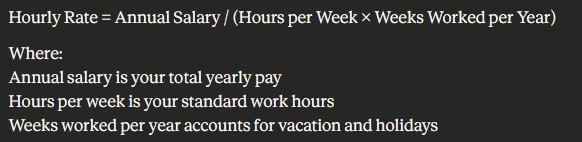
To find weeks worked, start with 52 weeks in a year. Subtract the weeks of vacation and holidays. For example, with 15 vacation days and 10 holidays, that is 25 days or 5 weeks off. So you work 47 weeks. Divide your annual salary by your hours per week times 47 weeks.
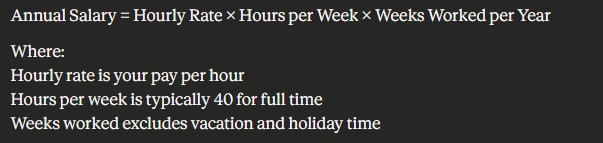
Multiply your hourly wage by how many hours you work each week. Then multiply that weekly amount by the number of weeks you actually work in a year. Remember to subtract vacation and holiday weeks from the 52 weeks in a year.

These conversions are straightforward because there are always 12 months in a year. To go from monthly to annual, multiply by 12. To go from annual to monthly, divide by 12. Most salaried positions quote monthly or annual figures using these simple multipliers.
| Hourly Rate | Annual (40h/wk) | Monthly | Weekly | Daily |
|---|---|---|---|---|
| $10 | $20,800 | $1,733 | $400 | $80 |
| $15 | $31,200 | $2,600 | $600 | $120 |
| $20 | $41,600 | $3,467 | $800 | $160 |
| $25 | $52,000 | $4,333 | $1,000 | $200 |
| $30 | $62,400 | $5,200 | $1,200 | $240 |
| $35 | $72,800 | $6,067 | $1,400 | $280 |
| $40 | $83,200 | $6,933 | $1,600 | $320 |
| $45 | $93,600 | $7,800 | $1,800 | $360 |
| $50 | $104,000 | $8,667 | $2,000 | $400 |
Let me show you how this works with realistic numbers. Suppose you have a job offer paying 4000 dollars per month. You will work 40 hours per week for 5 days per week. The company gives you 10 paid holidays and 15 vacation days per year.
First, calculate your annual salary. Multiply 4000 by 12 to get 48000 dollars per year.
Now find your hourly rate. Start by figuring out how many weeks you actually work. You have 15 vacation days plus 10 holidays, which totals 25 days off. Divide 25 by 5 days per week to get 5 weeks off.
Subtract 5 from 52 weeks to get 47 working weeks per year.
Calculate total working hours per year. Multiply 40 hours per week by 47 weeks to get 1880 hours.
Divide your annual salary by total hours. That is 48000 divided by 1880, which equals approximately 25.53 dollars per hour.
Your hourly rate is about 25.53 dollars.
For your weekly pay, multiply your hourly rate by hours per week. That is 25.53 times 40, which equals 1021.20 dollars per week.
For your daily rate, divide weekly pay by days worked. That is 1021.20 divided by 5, which equals 204.24 dollars per day.
For biweekly pay, multiply weekly by 2. That is 1021.20 times 2, which equals 2042.40 dollars every two weeks.
Now you can compare this offer to one paying 27 dollars per hour. At 27 dollars per hour working the same schedule, you would earn 27 times 40 times 47, which equals 50760 dollars per year or about 4230 dollars per month. The hourly job pays more.
Gross salary is your total pay before any deductions like taxes, insurance, or retirement contributions. Net salary is what you actually take home after all deductions. This calculator shows gross amounts. Your actual take home pay will be lower depending on your tax bracket and benefit elections. Expect to lose 20 to 30 percent or more to various deductions depending on your situation.
Full time work is typically 40 hours per week in most countries and industries. Some positions consider 35 to 37.5 hours as full time. Part time is usually anything less than 30 hours per week. Your employment contract should specify your expected hours. The number of hours affects benefits eligibility and overtime calculations.
Compare jobs using annual salary and total compensation including benefits. Two jobs might have different hourly rates but one offers more vacation days or better health insurance. Calculate the annual value of all benefits to make fair comparisons. Also consider factors like commute time, work from home options, and career growth potential that have financial value but are not direct salary.
Overtime is typically paid at 1.5 times your regular hourly rate for hours worked beyond 40 in a week. Some states or contracts have different rules. To calculate, find your hourly rate using this calculator, then multiply by 1.5 to get your overtime rate. Salaried employees may or may not be eligible for overtime depending on their classification as exempt or non exempt.
When evaluating salary offers or planning salary negotiations, percentage calculations become very useful. You might want to know what percentage increase a raise represents or calculate the percentage difference between two job offers. Our Percentage Calculator helps you quickly solve these percentage problems without manual math. You can determine if a 3000 dollar raise on a 50000 dollar salary is better than a 5 percent increase on a 60000 dollar salary. Visit the Percentage Calculator to make smart comparisons and ensure you are getting fair compensation for your work.
“Data based on IRS federal tax guidelines. Learn more at irs.gov“
Disclaimer: This calculator provides estimates for general information only and does not constitute financial advice. Please consult a qualified financial advisor before making financial decisions.
© 2026 CalcVersa. All rights reserved.