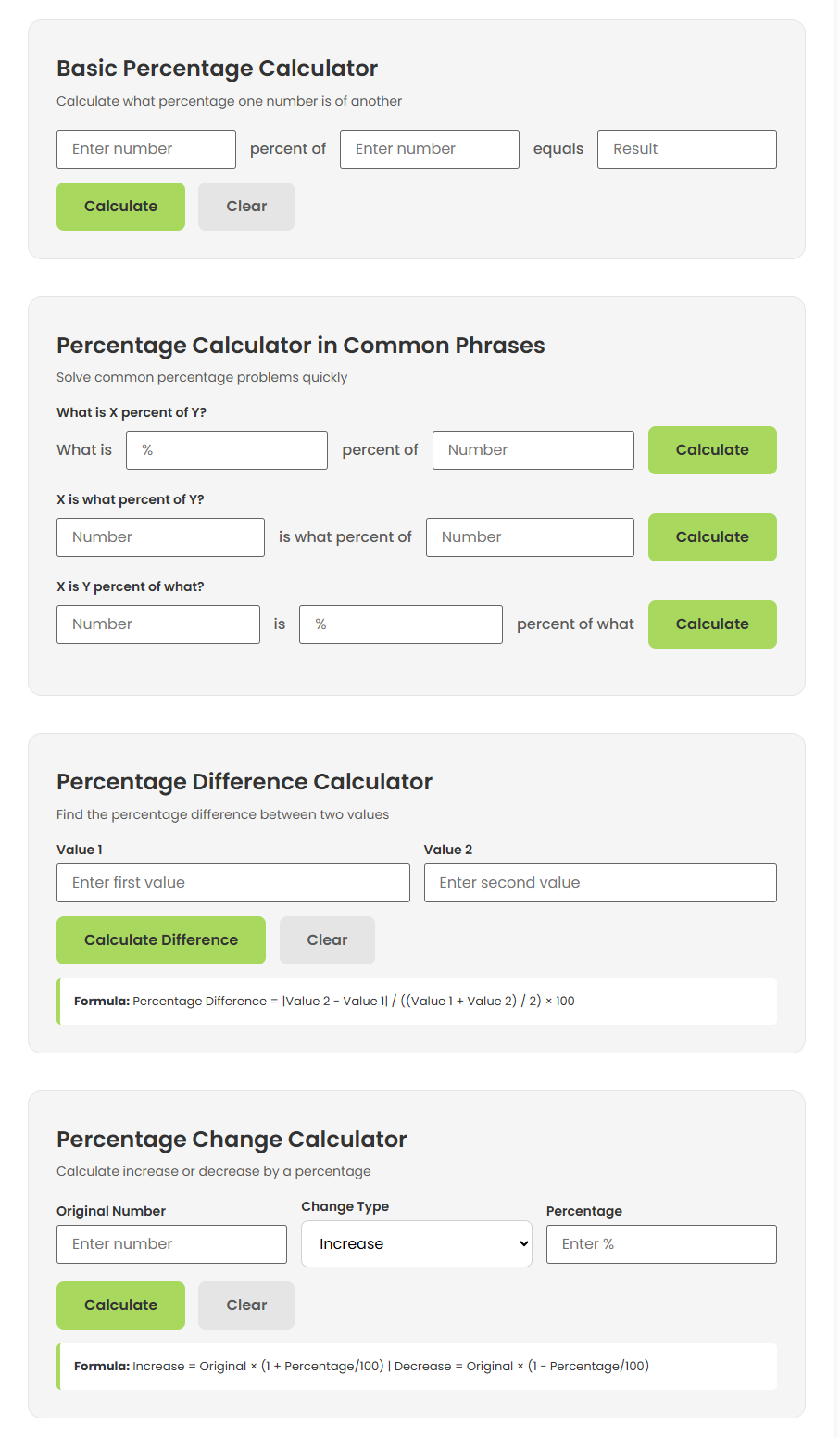
Calculate what percentage one number is of another
Solve common percentage problems quickly
Find the percentage difference between two values
Calculate increase or decrease by a percentage
Need to calculate percentages quickly without pulling out a calculator or doing mental math? Our percentage calculator makes it simple to solve any percentage problem in seconds. This tool is perfect for students working on homework, shoppers calculating discounts, business professionals analyzing data, or anyone dealing with percentages in daily life. The calculator handles multiple types of percentage calculations including basic percentages, percentage differences between two values, and percentage increases or decreases. You just enter your numbers and let the tool do the work. Whether you want to know what 20 percent of 150 is, calculate the percentage difference between two prices, or figure out how much something increased or decreased by, this calculator gives you accurate answers instantly. No complicated formulas to remember or manual calculations required.
The simplest function calculates what percentage one number is of another. For example, if you want to know what 25 percent of 200 equals, you enter 25 as the percentage and 200 as the total value. The calculator multiplies the percentage by the total and divides by 100 to give you the result. This type of calculation is useful for finding discounts, calculating tips, determining tax amounts, or solving school math problems. You can also use it to answer questions like what number is 15 percent of 80 or find 30 percent of any value you enter.
This section helps you solve percentage problems the way they are actually asked in real life. Instead of just entering raw numbers, you can choose from common question formats. One format asks what is X percent of Y, which gives you a specific portion of a total. Another asks X is what percent of Y, which tells you what percentage one number represents of another. The third format asks X is Y percent of what, which finds the total when you know a part and its percentage. These natural language options make the calculator easier to use because you simply match your problem to the right format.
The percentage difference calculator finds the relative difference between two values. This is useful when comparing prices, measurements, or any two numbers where you want to know how much they differ as a percentage. The calculator takes both values, finds the absolute difference, divides by the average of the two numbers, and multiplies by 100. The percentage change calculator works similarly but measures increase or decrease from an original value to a new value. You enter the starting number, select whether it increased or decreased, and enter the percentage change. The calculator then shows you the final value after applying that percentage change.
To find a percentage of any number, divide the percentage by 100 to convert it to a decimal, then multiply by your total value. For example, to find 20 percent of 50, calculate 20 divided by 100 equals 0.20, then 0.20 times 50 equals 10.
The formula for women is almost identical except it subtracts 161 instead of adding 5. This accounts for the generally lower metabolic rate in women due to differences in body composition. Women typically have higher body fat percentages and lower muscle mass than men of similar size.
This formula finds the absolute difference between two values and expresses it as a percentage of their average. The absolute value means the order of the numbers does not matter. The result is always positive.
For an increase, add the percentage to 100 and multiply by the original. For a decrease, subtract the percentage from 100 and multiply by the original. This gives you the final value after applying the percentage change.
Let me show you practical examples you might encounter while shopping. Suppose a jacket originally costs 80 dollars and the store offers a 25 percent discount. How much do you save and what is the final price?
First, calculate the discount amount using the basic percentage formula. Take 25 divided by 100 to get 0.25. Multiply 0.25 by 80 to get 20 dollars.
You save 20 dollars with this discount.
To find the final price, subtract the discount from the original price. That is 80 minus 20, which equals 60 dollars.
The jacket costs 60 dollars after the discount.
Now suppose you see another jacket that was 100 dollars but is now on sale for 70 dollars. What percentage discount is this?
Find the difference first. That is 100 minus 70, which equals 30 dollars off.
Divide the discount by the original price. That is 30 divided by 100, which equals 0.30.
Multiply by 100 to convert to percentage. That is 0.30 times 100, which equals 30 percent.
The second jacket has a 30 percent discount.
Finally, suppose your salary was 50000 dollars and you got a 10 percent raise. What is your new salary?
Calculate the raise amount. Take 10 divided by 100 to get 0.10. Multiply 0.10 by 50000 to get 5000 dollars.
Add this to your original salary. That is 50000 plus 5000, which equals 55000 dollars.
Your new salary is 55000 dollars per year.
The easiest method is to convert the percentage to a decimal by moving the decimal point two places left, then multiply by your total. For example, 15 percent becomes 0.15. To find 15 percent of 200, just multiply 0.15 times 200 to get 30. This works for any percentage calculation and only requires simple multiplication.
Find the difference between the new and old values. Divide this difference by the original value. Multiply the result by 100 to get the percentage. If the new value is higher, it is an increase. If lower, it is a decrease. For example, if something goes from 50 to 60, the difference is 10, divided by 50 is 0.20, times 100 is a 20 percent increase.
Percentage change measures how much something increased or decreased from a starting value. It has a direction and can be positive or negative. Percentage difference compares two values without considering which came first. It measures how far apart they are relative to their average. Use percentage change for before and after comparisons. Use percentage difference when comparing two separate things.
Divide the smaller number by the larger number, then multiply by 100. For example, to find what percentage 30 is of 120, divide 30 by 120 to get 0.25, then multiply by 100 to get 25 percent. This tells you that 30 represents 25 percent of 120. This is useful for finding what portion something represents of a total.
Understanding percentages is closely connected to managing your overall health and nutrition. When you know your daily calorie needs, you can calculate what percentage of those calories should come from proteins, carbohydrates, and fats for a balanced diet. Our Calorie Calculator helps you determine your total daily energy requirements based on your body measurements and activity level. You can then use percentage calculations to split those calories across different macronutrients for optimal health. Check out the Calorie Calculator to create a personalized nutrition plan that supports your fitness and wellness goals.