Time Value of Money Calculator

Calculate present value, future value, periodic payments, interest rates, and investment growth in seconds.

TVM Calculator | CalcVersa

Enter Your Values

Enter the time in years.
Payment Timing

Your Result

Future Value

$0.00

after 10 years at 6.5% compounded annually

Starting Amount $10,000.00
Total Contributions $2,500.00
Interest Earned $0.00
Investment growth chart A chart showing how the investment changes over the selected period.

Your calculations stay in your browser.
What Is the Time Value of Money?

The Time Value of Money Calculator helps you estimate future value, present value, periodic payments, interest rates, and investment periods. Enter your financial details to receive an instant result, contribution breakdown, and visual growth chart.

The time value of money, commonly shortened to TVM, is the financial principle that money available today is generally worth more than the same amount received in the future. Money held today can be saved or invested and may grow over time through interest or investment returns.

A TVM calculation helps you compare money across different periods. It can be used to estimate how savings may grow, determine how much a future amount is worth today, calculate the payment needed to reach a financial goal, or find the rate of return required for an investment.

Time value of money calculator

How to use the TVM Calculator

01

document-list

Choose a value

Select whether you want to calculate future value, present value, periodic payment, annual interest rate, or the required number of periods.

02

settings

Enter your details

Enter the available amounts, interest rate, time period, compounding frequency, and payment timing. The calculator will automatically remove the field that it needs to calculate.

03

Calculate and compare

Select Calculate TVM to view the result, contribution breakdown, estimated interest earned, and a visual growth chart.

One Calculator. Many Financial Decisions.

bank-lime

Savings Growth

Estimate how your current savings and regular contributions may grow over time.

loan-document-lime

Loan Planning

Compare present and future values to better understand long-term borrowing costs and payment requirements.

retirement-growth-lime

Retirement Goals

Estimate the amount you may need to save regularly to work toward a future retirement goal.

investment-growth-lime

Investment Returns

Calculate the potential future value of an investment using an expected annual rate of return.

TVM Calculation Example

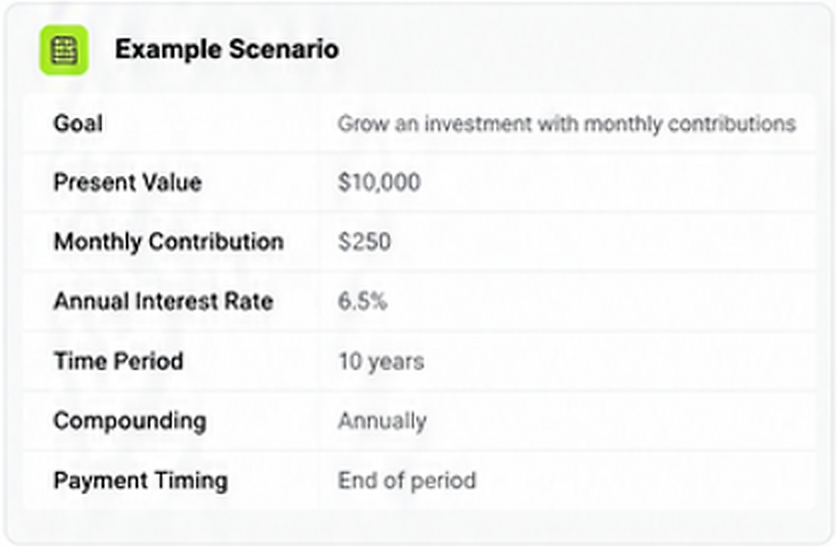
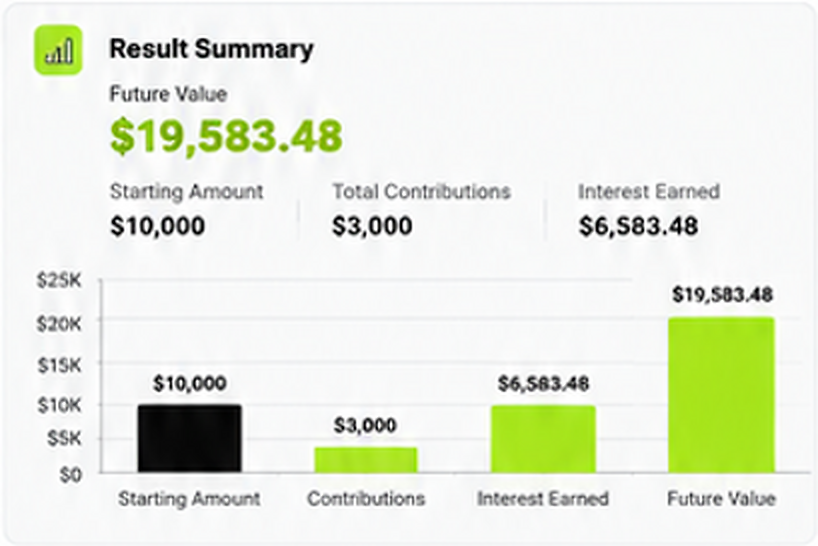
Suppose you invest $10,000 today and contribute an additional $250 at the end of every year. The investment earns an annual return of 6.5% and compounds annually for 10 years.
example-scenario-card
result-summary-card

How to Use the TVM Calculator (text version)

  1. Choose what to calculate — future value, present value, periodic payment, interest rate, or number of periods — from the dropdown menu.
  2. Enter the values you know — present value, annual interest rate, number of years, compounding frequency, and any periodic payment amount.
  3. Click Calculate to see your result with a contribution breakdown and visual growth chart.

Key TVM Formulas

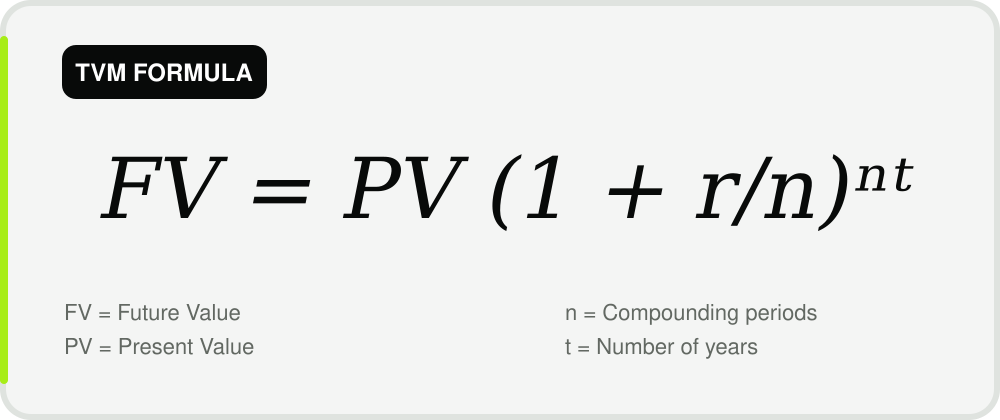
  • Future Value: FV = PV × (1 + r)^n
  • Present Value: PV = FV ÷ (1 + r)^n

Where PV = present value, FV = future value, r = interest rate per period, n = number of periods.

Worked Example: Present Value

You want $50,000 in 10 years and expect a 6% annual return, compounded annually. How much must you invest today?

PV = 50,000 ÷ (1.06)^10 = 50,000 ÷ 1.7908 = $27,920

Investing about $27,920 today at 6% grows to $50,000 in 10 years – the remaining $22,080 comes from compound growth, not your pocket.

Related Tools

TVM stands for time value of money. It describes how money available today may be worth more than the same amount received later because today’s money can potentially earn interest or investment returns.

Present value is the current worth of money or a future cash flow. Future value is the estimated amount that money may grow to after earning interest over a specified period.

Compounding means interest is added to the original amount and may then earn additional interest. Common compounding frequencies include annually, quarterly, monthly, weekly, and daily.

Yes. Enter an amount in the Periodic Payment field to include regular contributions. You can also specify whether payments are made at the beginning or end of each period.

Beginning-of-period payments are added before interest is calculated for that period. End-of-period payments are added afterward. Beginning payments therefore have more time to potentially earn interest.

Yes. Select Annual Interest Rate from the calculation dropdown and enter the remaining required values. The calculator will estimate the annual rate needed to reach the specified future value.

No. Calculations are completed locally in your browser. CalcVersa does not upload or store the financial values entered into this calculator.

No. This calculator provides estimates for general educational and planning purposes. It should not be considered financial, investment, tax, or legal advice.

Disclaimer: This calculator provides estimates for general information only and does not constitute financial advice. Please consult a qualified financial advisor before making financial decisions.