
Quick Answer
American Wire Gauge is the wire measurement system used in the United States. The lower the American Wire Gauge number, the bigger the wire, and hence it can carry more electricity. As an illustration, 12 gauge (can carry 20 amps) wires are used in the kitchen while 14 gauge (15 amps) are used in normal lights. |
One of the biggest, and most dangerous, electrical errors made by homeowners or builders alike involves picking the incorrect wire gauge. No matter whether you are working on installing a new outlet, replacing your electrical panel or fixing issues with circuit breakers, it is vital to understand the intricacies of American Wire Gauge (AWG).
Here we have compiled all of the important information related to American Wire Gauge sizing and usage. From what AWG actually is to how to size wires based on load requirements, all of your questions can be found here. There are currently more than 8,100 monthly searches on AWG wire size alone, with an impressive topic efficiency score.
In other words, this is a guide everyone needs.
What Is American Wire Gauge (AWG)?
American Wire Gauge (AWG), or Brown & Sharpe wire gauge, is the internationally recognized system that determines the size of electrically conducting wires used in the US, Canada, and many other countries. The American Wire Gauge system was developed in 1857; since then, it has become an official industry standard for measuring copper and aluminum wires.
AWG refers to solid round, electrically conducting wires. Other types of cables (such as optical fiber or construction cables) have other measures. If you want to measure electrical wires in houses and office buildings, AWG will be useful to you.
Facts about American Wire Gauge (AWG):
- AWG range starts at 0000 (4/0), the largest type of AWG, and ends at 40 AWG, the smallest.
- The lower AWG number equals the bigger diameter of the wire.
- 14, 12, 10, 8, and 6 AWG are most popular for household uses.
- For each reduction by 3 AWG numbers, there is a doubling of the cross-sectional area of the wire.
How the AWG System Works
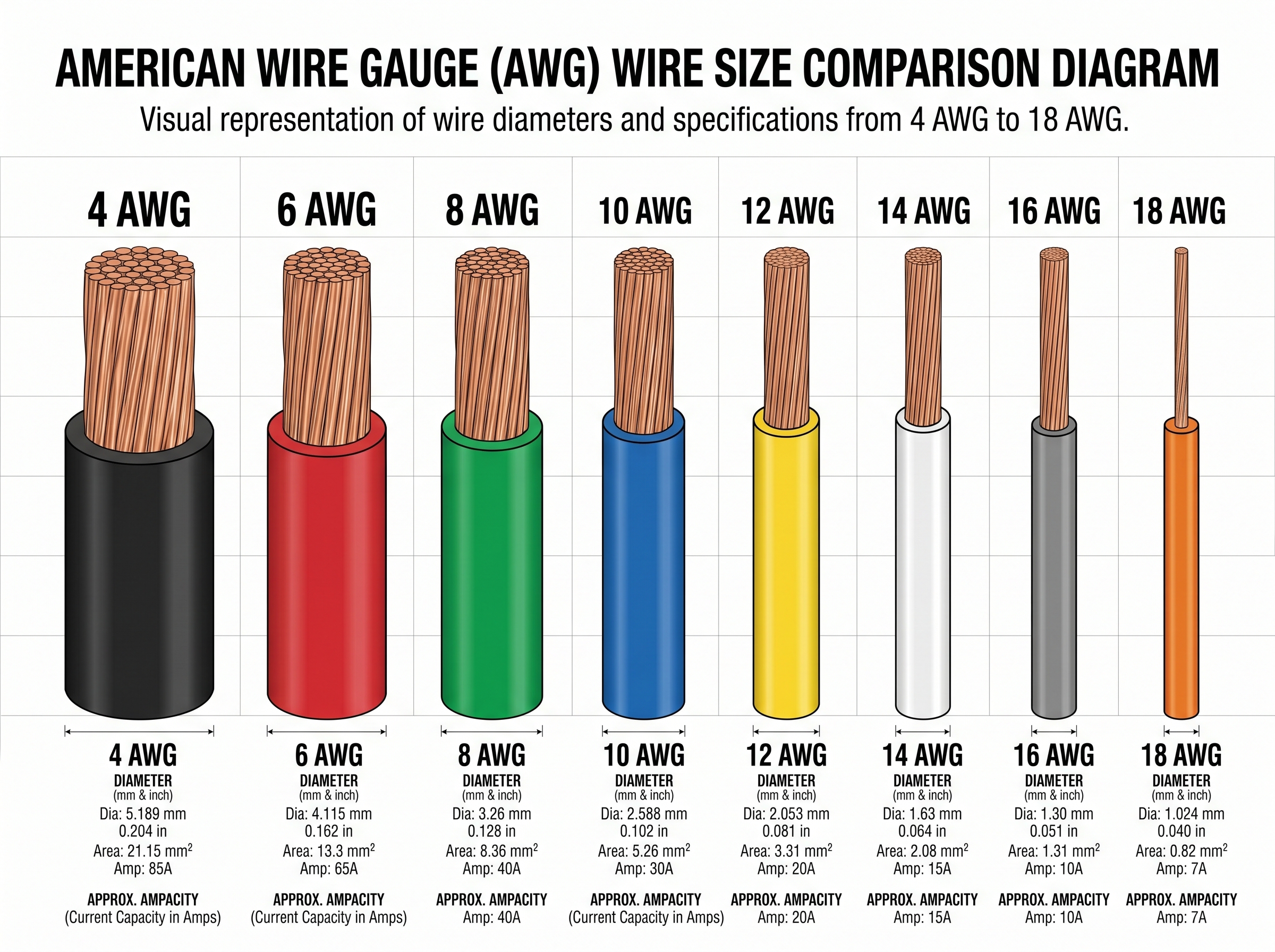
AWG Gauge may appear paradoxical on its face, but the greater the number, the thinner the wire. This is based on how the wires are made; the number indicates the number of passes made by the wire to get drawn through dies.
The AWG Formula
For those who want the technical details, the diameter of an AWG wire in inches follows this formula:
Diameter (inches) = 0.005 inches × 92^((36 – AWG) / 39)
In practice, you do not need to memorize the formula. The AWG wire size chart in the next section does the heavy lifting for you.
Solid vs. Stranded Wire
The solid wire, on the other hand, is made up of one conductor and is more rigid but less expensive than the stranded type of wire. The stranded wire has more than one conductor twisted together and is thus more flexible compared to solid wire; it is preferred for areas that require frequent vibrations.
AWG Wire Size Chart & Ampacity Table
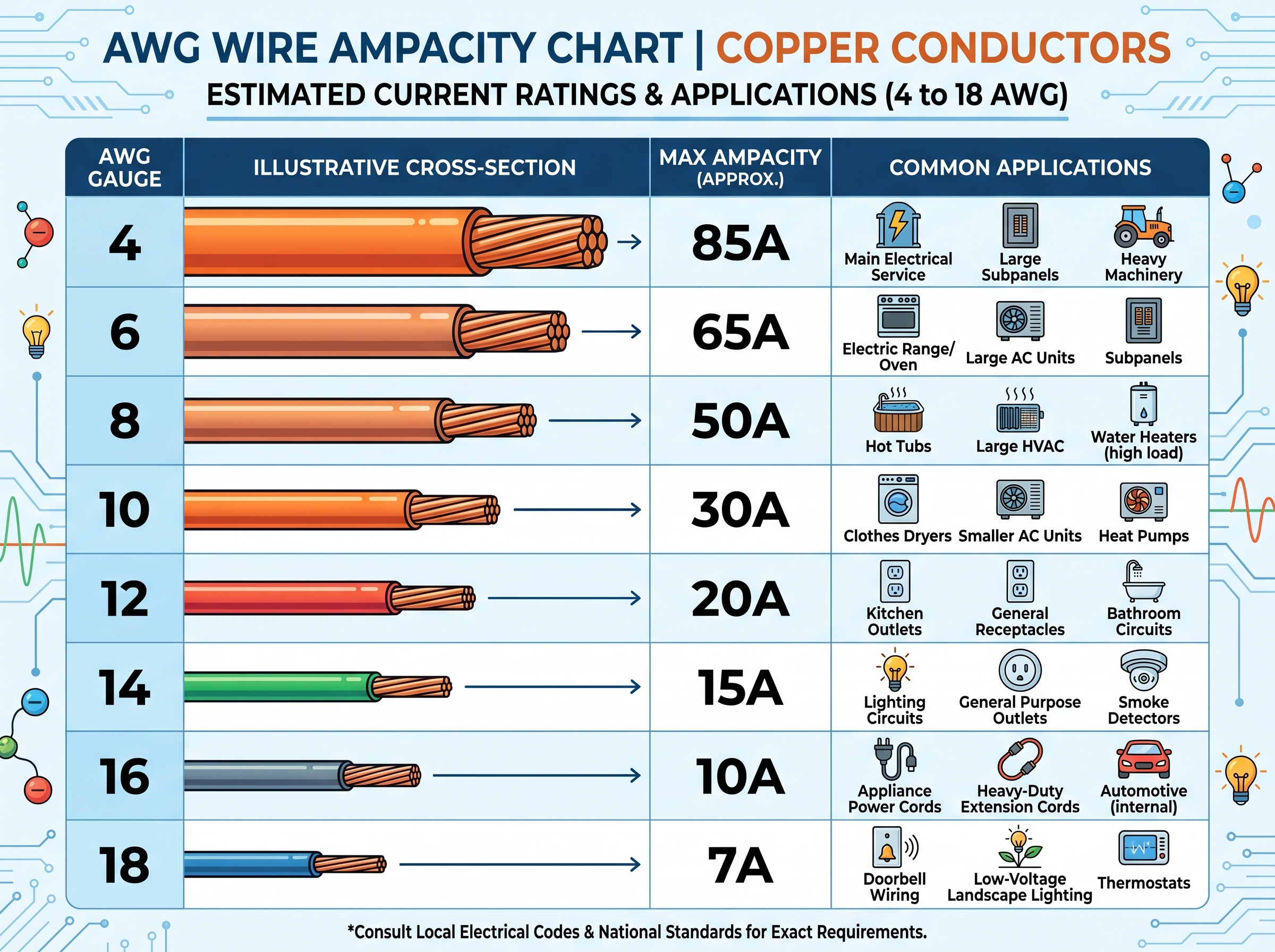
The ampacity of an electrical conductor is the maximum amount of electric current that the conductor can transmit continuously while still maintaining the prescribed temperature rating. According to the National Electrical Code, the ampacity rating for copper wires can be 60°C, 75°C, or 90°C, depending on the wire insulation rating. Below is the chart using a 60°C rating.
AWG Wire Size Chart (Copper, 60°C Rating, NEC Standard)
AWG Size | Diameter (mm) | Max Ampacity | Common Use |
|---|---|---|---|
4 AWG | 5.19 mm | 85 A | Large sub-panels, EV chargers |
6 AWG | 4.11 mm | 65 A | AC units, hot tubs |
8 AWG | 3.26 mm | 40 A | Ovens, dryers |
10 AWG | 2.59 mm | 30 A | Water heaters, 240V appliances |
12 AWG | 2.05 mm | 20 A | Kitchen, bathroom circuits |
14 AWG | 1.63 mm | 15 A | General lighting, outlets |
16 AWG | 1.29 mm | 13 A | Extension cords, light fixtures |
18 AWG | 1.02 mm | 10 A | Low-voltage, doorbells, thermostats |
Note: Ampacity values are for copper conductors. Aluminum wire requires two sizes larger for equivalent ampacity (e.g., use 10 AWG aluminum where 12 AWG copper would suffice)
How to Determine the AWG Wire Size You Need
Gauging the appropriate wire gauge depends on three critical criteria: the current capacity of the electrical circuit, the length of the wire, and the nature of the load. Here are some steps you can take when deciding on your wire gauge.
Step-by-Step Wire Sizing Process
- Find out what size your circuit breaker is. Look inside the breaker box, and note the number stamped on the breaker (15A, 20A, or 30A). This gives the maximum current for that circuit.
- Compare the breaker size to the minimum wire gauge. A 15A breaker needs 14 AWG. A 20A breaker needs 12 AWG. And a 30A breaker needs 10 AWG.
- Determine how far the wiring will travel. Runs longer than 50 feet require bigger wires because of voltage drop (See Section 8).
- Identify whether there is continuous load on the wire. Loads operating continuously for over three hours need to be limited to 80% of wire ampacity.
- Check whether any other factors affect the conduit fill. In cases where several wires go through a conduit, refer to NEC Table 310.15(B)(3)(a).
Quick-Reference Rule of Thumb
The '15/20/30 Rule' for residential wiring:
- 15-amp circuit = 14 AWG wire
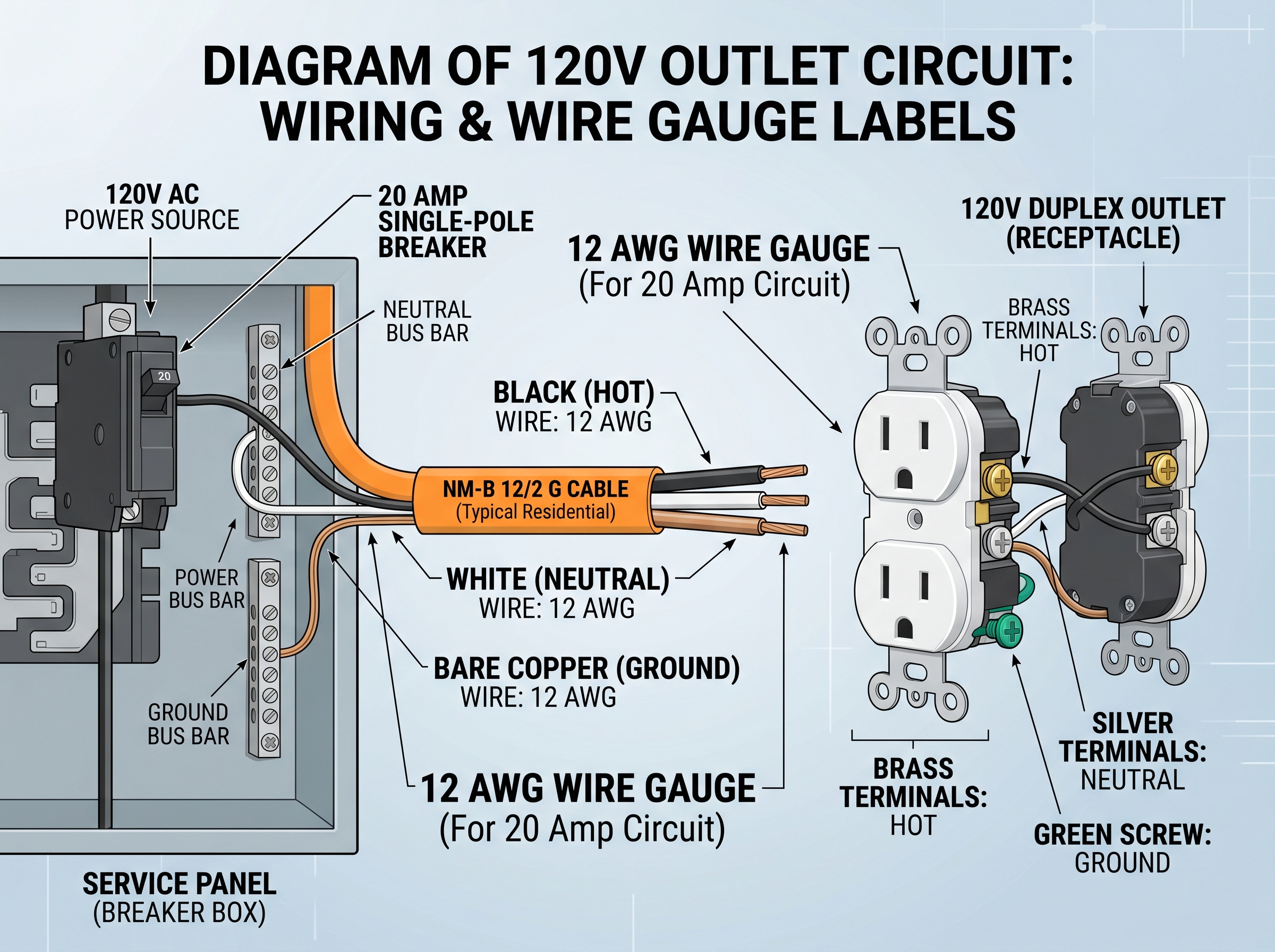
- 20-amp circuit = 12 AWG wire
- 30-amp circuit = 10 AWG wire
- 40-amp circuit = 8 AWG wire
- 50-amp circuit = 6 AWG wire
What Size Wire Do I Need for a 120-Volt Circuit?
Typically, most home electrical outlets and light circuits are powered by 120 volts. The size of the wiring is determined by the amps in the circuit and not the voltage. Below are the recommendations from the NEC for typical 120-volt circuits:
Application | Circuit Amperage | Wire Gauge | Breaker Size |
|---|---|---|---|
General outlets | 15A | 14 AWG | 15A |
Kitchen/bath outlets | 20A | 12 AWG | 20A |
Refrigerator | 20A | 12 AWG | 20A |
Microwave | 20A | 12 AWG | 20A |
Garage/outdoor outlets | 20A | 12 AWG | 20A |
Small appliances | 15–20A | 12–14 AWG | 15–20A |
Typical blunder: 14 gauge wire must never be used in a 20 amp circuit since the wire can heat up when carrying 20 amps continuously, which will eventually lead to a fire. The safest thing to do is to use a thicker wire in case of uncertainty.
How to Identify Wire Gauge on a Circuit Breaker
There are two ways to determine the wire gauge that is used on a circuit breaker. They include examining the wire insulation and determining the diameter of the wire. Below is how you can accomplish this without putting yourself in danger.
Method 1: Read the Wire Insulation
Most modern electrical wire has the gauge and other specifications printed directly on the insulation. Look for text like:
“12 AWG 600V NM-B” or “14-2 WITH GROUND”
The first number (12 or 14) is the gauge. “NM-B” stands for Non-Metallic Sheathed Cable (Romex), and “600V” is the voltage rating.
Method 2: Measure the Wire Diameter
If the insulation is worn or unmarked, use a wire gauge tool or digital calipers to measure the bare conductor diameter. Then compare it to the AWG diameter chart:
- 14 AWG: 1.63 mm (0.064 inches) bare conductor
- 12 AWG: 2.05 mm (0.081 inches) bare conductor
- 10 AWG: 2.59 mm (0.102 inches) bare conductor
Safety Warning
IMPORTANT: It is imperative that you switch off the circuit breaker first. It is also necessary to ensure that the wire is not energized using a voltage detector.
Common Wire Gauge Applications
Understanding which wire gauge fits which application saves time, money, and prevents hazards. Here is a practical breakdown of the most common residential and light commercial uses:
14 AWG Wire
- Standard lighting circuits (15A breaker)
- General-purpose wall outlets in living rooms and bedrooms
- Low-load appliances like lamps and fans
12 AWG Wire
- Kitchen and bathroom outlets (20A breaker)
- Refrigerators, dishwashers, and microwaves
- Garage and outdoor GFCI outlets
10 AWG Wire
- Electric dryers and ranges (30A breaker)
- Central air conditioning units up to 3 tons
- Hot water heaters
8 AWG Wire
- Large electric ranges and ovens (40A breaker)
- EV charger Level 2 circuits (in some configurations)
- High-load HVAC equipment
6 AWG Wire
- 60-amp sub-panels for garages or workshops
- Large heat pumps and air handlers
- Commercial cooking equipment
Wire Gauge and Voltage Drop
A voltage drop happens because electrical resistance causes a decrease in the amount of voltage that reaches the other end of the wire. The National Electric Code suggests that the voltage drop be kept to under 3% on a branch circuit and no more than 5% overall for both the feeder and the branch circuit.
Voltage Drop Quick Guide
For a 120V, 15A circuit at various distances:
- Up to 50 ft: 14 AWG is sufficient
- 50–100 ft: Upgrade to 12 AWG to maintain voltage
- 100–150 ft: Upgrade to 10 AWG
- Over 150 ft: Consult a licensed electrician for proper sizing
This is particularly crucial for outdoor lighting, detached garages, workshops, and swimming pool apparatus, which will require longer wire runs. Utilizing small gauge wire for long wire runs results in overheating motors, dimming lights, and sub-par performance of household appliances.
Ready to Start Your Wiring Project?
Use our free wire gauge calculator to find the exact AWG size for your project – enter your amperage, wire length, and material, and get a code-compliant recommendation instantly.