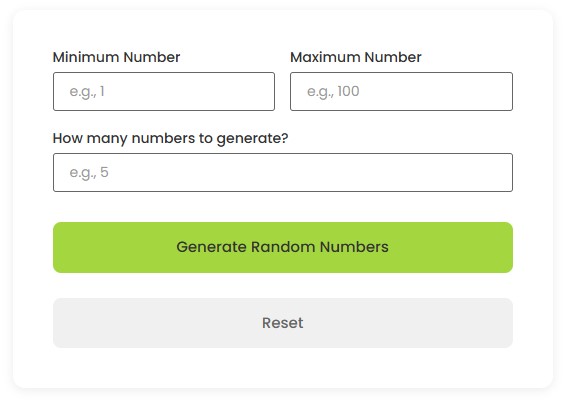
Need random numbers for a game, raffle, statistical sampling, or any other purpose? Our random number generator creates truly random numbers within any range you specify. This tool is perfect for teachers creating random student groups, gamers rolling virtual dice, organizers running fair lottery drawings, researchers selecting random samples, developers testing applications, or anyone needing unpredictable numbers. You simply set your minimum and maximum values to define the range, then choose how many random numbers you want to generate. The tool instantly produces your random numbers with each one having an equal chance of being selected. Unlike predictable patterns or biased human choices, this generator uses algorithms designed to produce genuine randomness. You can generate a single number or hundreds at once, and you can use any range from small numbers like 1 to 10 or large numbers reaching into the millions.
The first step is defining the range of numbers you want to work with. Enter your minimum number, which is the smallest number that can be generated. Then enter your maximum number, which is the largest possible number. For example, if you want to simulate rolling a standard six sided die, you would set minimum to 1 and maximum to 6. If you need to pick a random number between 1 and 100, set those as your bounds. The range can be as narrow or as wide as you need. You can even use negative numbers if your application requires them.
Next, specify how many random numbers you want the tool to create. If you need just one random number for a single choice or decision, enter 1. If you are running a raffle with 50 winners, enter 50. If you need random data for statistical analysis, you might generate hundreds or thousands of numbers. The generator produces each number independently, so the same number can appear multiple times in your results unless you specifically need unique numbers. Each generation is a fresh random selection within your specified range.
When you click generate, the tool uses a pseudorandom number generation algorithm. This is a mathematical process that produces numbers that appear random and pass statistical tests for randomness even though they are calculated using a formula. The algorithm starts with a seed value, often based on the current time down to milliseconds, ensuring different results each time you use the tool. It then performs complex calculations to produce numbers that are uniformly distributed across your specified range. Each number has an equal probability of being selected, making the results fair and unpredictable for practical purposes.
The algorithm first generates a random fraction between 0 and 1. This fraction is then scaled to fit your desired range. Multiply the fraction by the span of your range, which is maximum minus minimum plus 1. Add this to your minimum value. The result is rounded down to the nearest integer to give you a whole number within your specified bounds.
Probability of Any Number = 1 / (Maximum – Minimum + 1)
In a truly random generator, every number in your range has an equal chance of being selected. If your range is 1 to 100, that is 100 possible numbers. Each number has a 1 in 100 chance or 1 percent probability of being chosen on any single generation. This uniform distribution ensures fairness and prevents bias toward any particular number.
Let me walk you through a practical example. Suppose you are a teacher with 30 students and you want to randomly select 5 students to present their projects first.
Set your minimum number to 1 and maximum number to 30, representing your 30 students numbered 1 through 30.
Enter 5 as the quantity of numbers to generate since you need to pick 5 students.
Click the generate button.
The tool might produce results like: 7, 23, 12, 30, 15.
These numbers correspond to students 7, 23, 12, 30, and 15 in your class list. They will present first in that order.
Each number had an equal 1 in 30 chance of being selected. Student 1 had the same probability as student 30. This ensures fairness and removes any teacher bias from the selection process.
If you notice that student 7 appears twice in your results and you need unique selections, you can generate again or manually replace the duplicate. Some advanced generators offer a “no duplicates” option.
For another example, imagine you want to simulate rolling two standard dice for a board game. Set minimum to 1 and maximum to 6. Generate 2 numbers. You might get 4 and 5, meaning you rolled a 4 and a 5. Add them together for a total of 9 for your game move.
This generator uses pseudorandom algorithms that produce numbers that are random enough for most practical purposes including games, raffles, and statistical sampling. The numbers pass standard randomness tests and cannot be predicted by users. However, they are not truly random in the cryptographic sense because they are calculated using mathematical formulas. For security critical applications like encryption keys, use specialized cryptographic random number generators instead.
The basic random number generator can produce duplicate numbers because each generation is independent. If you need unique numbers, you have a few options. Generate more numbers than you need and manually remove duplicates. Use the generator multiple times and skip any repeats. Some advanced versions of this tool offer a unique numbers option that guarantees no duplicates in a single generation session.
Random number generators have countless applications. Teachers use them for random student selection and creating fair teams. Organizers use them for lottery drawings, raffle winners, and contest selections. Gamers use them to simulate dice rolls and card shuffles. Researchers use them for random sampling in experiments and surveys. Developers use them for testing, creating temporary passwords, and game development. Any situation requiring fair, unbiased selection benefits from random number generation.
This tool generates whole numbers or integers within your specified range. If you need decimal numbers or numbers with specific precision, you would need a specialized random decimal generator. For most applications like selecting winners, rolling dice, or picking lottery numbers, whole numbers are what you need. The integer approach makes results easier to use and understand.
Random number generators are often used alongside percentage calculations in statistical work and probability exercises. When you generate random data, you might want to calculate what percentage of your numbers fall within certain ranges or what percentage of trials resulted in specific outcomes. Our Percentage Calculator helps you quickly analyze your random number results and convert counts into meaningful percentages. Visit the Percentage Calculator to perform these calculations and better understand the statistical properties of your randomly generated data.