
Solve for any unknown variable using the C₁V₁ = C₂V₂ equation
If you work in the laboratory and want to prepare a solution with particular concentration, then accurate calculations become an essential task. Thanks to a dilution calculator, you don’t have to do it manually; all you need to do is plug in numbers into the equation, which will instantly be solved.
In the following article, we will tell you what a dilution calculator is and show how to use it, as well as explain the underlying formula.
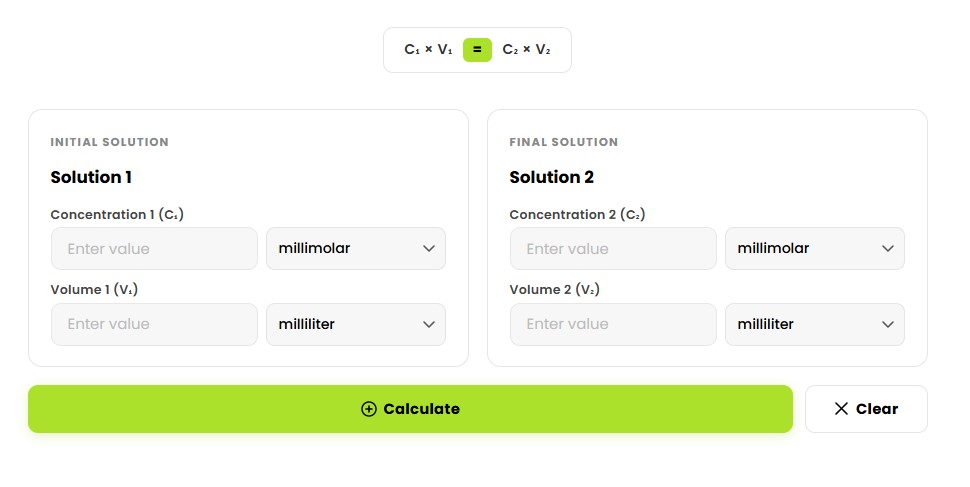
A dilution calculator is an easy-to-use online calculator that calculates the method for diluting the solution to get the new concentration. Instead of calculating the value manually, all that you need to do is to insert the known values in the solution dilution calculator and the calculator immediately solves the unknown variable.
Solution dilution calculators are extensively used in:
The use of a dilution ratio calculator ensures no human errors in calculation since any mistake in the calculation may influence the final result.
Every dilution calculator works on one core formula:
Where :
This is what all dilution calculators are based on, and this works due to the fact that there is no change in the amount of the solute, but rather a change in the volume and concentration.You can read more about the science behind this principle on Khan Academy’s guide to molarity and dilution.
When we already have three out of four values, we can use the following equation:
This is exactly how to calculate dilution factor manually – but a calculator does it for you instantly.
Using a dilution calculator mg/ml or any other unit-based version is straightforward. Here’s the process:
Examine your initial concentration and volume and your final concentration and volume. You usually have three out of the four variables (C₁, V₁, C₂, V₂) and the calculator finds the unknown one.
Under Initial Solution (Solution 1):
Under Final Solution (Solution 2):
Leave the one unknown value blank – this is the field the calculator will solve for.
Press on the Calculate button. This will automatically calculate your answer based on the C1V1 = C2V2 equation without having to do any mathematical manipulations manually.
The Clear button will clear all the fields should you choose to perform a new calculation using a different solution.
This will be the case whether you are working with the dilution calculator percent tool that uses percentages or the standard dilution calculator tool.
Dilution calculations should not only be accurate because of convenience, but also because mistakes in the process may ruin an entire experiment in laboratory studies, while in other fields like pharmaceuticals and chemistry, the result of inaccurate dilutions may bring health concerns. It is for such reasons that dilution calculators like the tocris dilution calculator are commonly used.
Say your stock solution is 100 mM and you need 100 mL of a 10 mM working solution:
The dilution factor here is 100 / 10 = 10-fold (a 1:10 dilution). Always add the stock first and bring up to the final volume with diluent – never assume the two volumes are simply additive for concentrated stocks.
The dilution factor is the ratio of final volume to stock volume: DF = V₂ / V₁. A 1:10 dilution (10 mL of stock brought up to 100 mL) has a dilution factor of 10, meaning the stock was diluted tenfold.
A serial dilution is a sequence of stepwise dilutions where each step uses the previous dilution as its starting solution. For example, five 1:10 steps produce a total 1:100,000 dilution - the standard way to reach very low concentrations accurately.
That means you are trying to concentrate, not dilute - your target concentration (C₂) is higher than your stock (C₁). Double-check the values: for a true dilution, the stock must be more concentrated than the target.
In chemical and biological labs, pharmaceutical preparation, industrial chemical mixing, and coursework. Anywhere a precise target concentration matters, the calculator removes manual arithmetic errors.
If you found this dilution calculator useful, you may also need these related tools:
The dilution calculator makes one of the simplest but potentially most error-ridden calculations in laboratory science easier. Learning about the formula C₁V₁ = C₂V₂ and then doing a step-by-step approach will enable one to calculate anything from dilution factors to solution volumes and concentrations.
© 2026 CalcVersa. All rights reserved.