Pragnancy Check Calculator

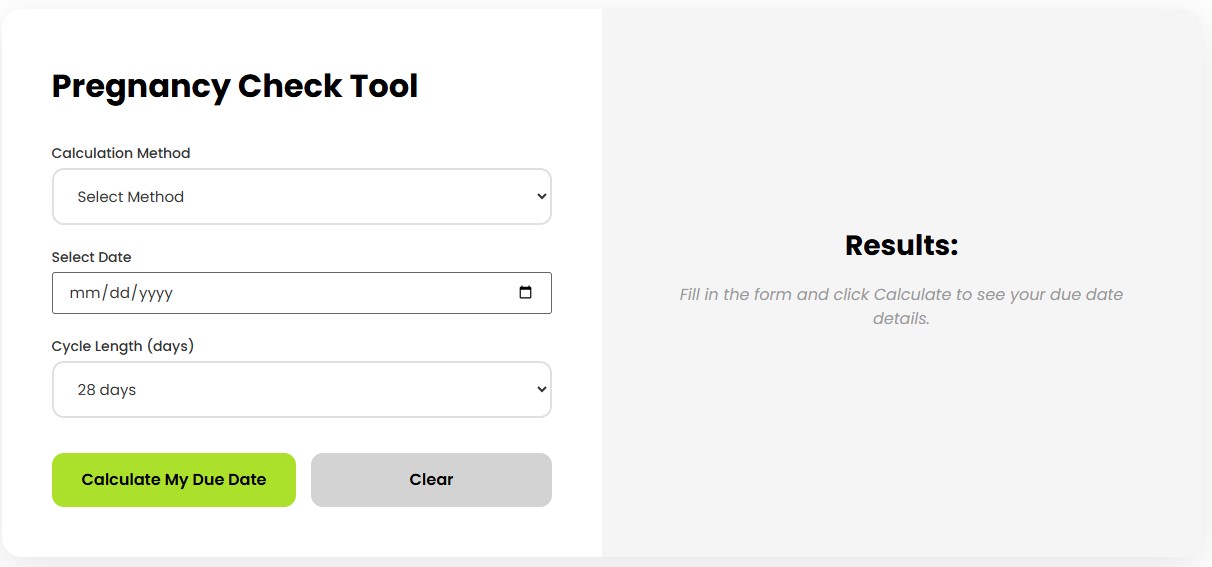
Pregnancy Check Tool

Pregnancy Check Tool

Please select a calculation method
Please select a valid date

Results:

Fill in the form and click Calculate to see your due date details.

Know About That Tool

Introduction

Wondering if you might be pregnant or trying to figure out your due date? Our pregnancy check calculator helps you estimate important pregnancy dates and milestones based on your menstrual cycle information. This tool is designed for women who are trying to conceive, suspect they might be pregnant, or have just confirmed their pregnancy and want to know more details. You simply enter the first day of your last menstrual period and your average cycle length. The calculator then estimates your conception date, current pregnancy week, and expected due date. This information helps you understand where you are in your pregnancy journey and when to expect your baby. 

How the Loan Calculator Works

Understanding Your Menstrual Cycle Data

The calculator needs two key pieces of information to give you accurate results. First is the first day of your last menstrual period, which is the day your last period started. This date serves as the starting point for all pregnancy calculations in the medical world. Second is your average cycle length, which is the number of days from the first day of one period to the first day of your next period. Most women have cycles between 21 and 35 days, with 28 days being average. If your cycles are irregular, use your best estimate or an average of your last few cycles. These two data points allow the calculator to estimate when you ovulated and conceived, which determines all other pregnancy dates.

Calculating Conception and Due Date

Once you enter your information, the calculator estimates your ovulation and conception date. Ovulation typically happens around 14 days before your next period starts, regardless of cycle length. For a 28 day cycle, this means ovulation occurs around day 14. For a 32 day cycle, ovulation happens around day 18. Conception usually occurs within 24 hours of ovulation. The calculator then adds 280 days or 40 weeks from your last period start date to estimate your due date. This is based on the standard pregnancy length of 40 weeks measured from the last menstrual period. Your actual pregnancy is only about 38 weeks from conception, but doctors use the 40 week timeline starting from your last period because it is easier to track.

Determining Your Current Pregnancy Week

The calculator also tells you how many weeks pregnant you are right now if you are already pregnant. It counts from the first day of your last period to today’s date and converts this into weeks and days. Pregnancy is divided into three trimesters. The first trimester is weeks 1 through 13, the second trimester is weeks 14 through 27, and the third trimester is weeks 28 through 40. Knowing your exact week helps you understand which pregnancy symptoms to expect, when to schedule prenatal appointments, and what developmental milestones your baby is reaching. The calculator might also show you upcoming important dates like when you can hear the heartbeat or find out the baby’s gender through ultrasound.

Formula Section

Ovulation Date Calculation

ovulation Data Calculation

This formula estimates when you ovulated by subtracting 14 days from your cycle length and adding that number to your period start date. The luteal phase, which is the time between ovulation and your next period, is fairly consistent at 14 days for most women. The follicular phase before ovulation is what varies in cycle length.

Conception Date Estimation

Conception Date = Ovulation Date + 1 day

Conception typically occurs within 24 hours after ovulation when the egg is viable. Sperm can survive in the reproductive tract for up to 5 days, but the egg only lives for about 12 to 24 hours. This means conception happens very close to ovulation day, usually the same day or the day after.

Due Date Calculation

Example Section

Calculating Pregnancy Dates for a Woman with 28 Day Cycle

Let me walk you through a complete example. Suppose the first day of your last menstrual period was January 1st and you have a regular 28 day cycle.

First, calculate your ovulation date. Since your cycle is 28 days, subtract 14 from 28 to get 14. Add 14 days to January 1st.

Your estimated ovulation date was January 15th.

Next, add one day to find your conception date. January 15th plus 1 day gives you January 16th as your likely conception date.

Now calculate your due date. Take January 1st and add 280 days.

January has 31 days, so after January 1st you have 30 days left in January. February has 28 days (assuming not a leap year), March has 31, April has 30, May has 31, June has 30, July has 31, August has 31, and September has 30.

Adding these up: 30 + 28 + 31 + 30 + 31 + 30 + 31 + 31 + 30 = 272 days through September. You need 8 more days, bringing you to October 8th.

Your estimated due date is October 8th.

If today is March 15th, let me calculate how far along you are. From January 1st to March 15th is 31 days remaining in January plus 28 days in February plus 15 days in March, which equals 74 days.

Divide 74 by 7 to get 10 weeks and 4 days. You are 10 weeks and 4 days pregnant, which puts you in your first trimester.

FAQ Section

Pregnancy calculators provide good estimates but are not perfectly accurate for everyone. They work best for women with regular cycles. Your actual due date can vary because not all pregnancies last exactly 40 weeks, and ovulation timing can differ. Only about 5 percent of babies arrive on their exact due date. Most are born within two weeks before or after the estimated date. Your doctor will use ultrasounds to confirm and possibly adjust your due date as your pregnancy progresses.

For the most accurate results, take a pregnancy test after you miss your period. This is typically about 14 days after conception or ovulation. Some sensitive tests can detect pregnancy as early as 10 days after conception, but false negatives are common when testing too early. If you test before your missed period and get a negative result but still do not get your period, test again a few days later. Morning urine gives the most reliable results because it has the highest concentration of pregnancy hormone.

If your cycles are irregular, pregnancy calculators are less accurate. Try using an average of your cycle lengths from the past few months. You can also use the date of conception if you know when you ovulated, perhaps from tracking ovulation with tests or monitoring body temperature. Your doctor will likely use an early ultrasound to date your pregnancy more accurately. Ultrasounds done in the first trimester are very accurate for determining due dates.

Yes, this calculator helps you identify your fertile window if you are trying to conceive. Your most fertile days are the 5 days before ovulation and the day of ovulation itself. Sperm can survive up to 5 days waiting for the egg. Having intercourse during this window gives you the best chance of pregnancy. The calculator shows you when to expect ovulation based on your cycle length, helping you time intercourse for the highest pregnancy success rate.

Related Tools Section

While planning for pregnancy or during your pregnancy journey, maintaining a healthy body composition is important for both fertility and pregnancy outcomes. Our Body Fat Calculator helps you assess whether your body fat percentage is in a healthy range for conception and pregnancy. Both very low body fat, which can disrupt hormones and stop ovulation, and very high body fat, which increases pregnancy complications, can affect your fertility and pregnancy health. Visit the Body Fat Calculator at https://calcversa.com/body-fat-calculator/ to check your body composition and ensure you are in the best physical condition for a healthy pregnancy and baby.