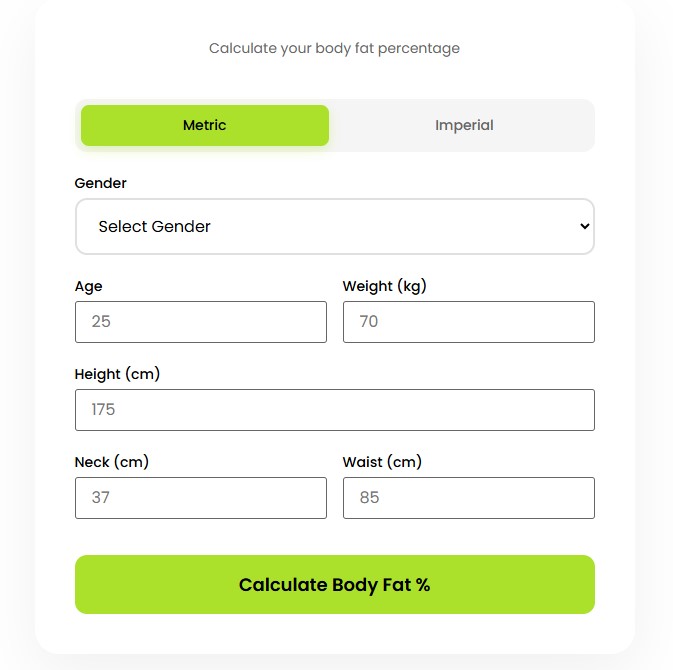
Calculate your body fat percentage
Want to know what percentage of your body is made up of fat? Our body fat calculator helps you estimate your body fat percentage using simple measurements you can take at home. This tool is valuable for anyone serious about fitness, weight loss, or overall health. Unlike the scale which only shows total weight, body fat percentage tells you how much of that weight is fat versus lean tissue like muscle, bone, and water. Two people can weigh the same but have completely different body compositions and health risks. Athletes might have low body fat with high muscle mass, while someone else at the same weight might have high body fat and low muscle. This calculator uses proven formulas based on your gender, age, weight, height, and body measurements like neck and waist circumference. You get an estimated body fat percentage that helps you understand your true fitness level and set better health goals.
The calculator requires several measurements to estimate your body fat percentage accurately. Start by selecting your gender and entering your age and weight. Then measure your height while standing straight. Next comes the important part, measuring body circumferences. For your neck, measure around the narrowest part just below the Adam’s apple while looking straight ahead. For your waist, measure around the widest part of your abdomen, usually at belly button level. Make sure the tape is snug but not tight and keep it parallel to the floor. Take measurements in the morning before eating for the most consistent results. Some calculators also ask for hip measurements for women since women store fat differently than men.
Most body fat calculators use the US Navy Method, which was developed by the military to assess fitness standards. This method estimates body fat based on the relationship between height and body circumferences. The logic is simple, people with larger waists relative to their height and neck size carry more body fat. The formula uses different equations for men and women because fat distribution patterns differ between genders. Men typically carry more fat around the midsection, while women store more fat in hips and thighs. The calculator processes your measurements through these gender specific formulas to produce an estimated body fat percentage.
After calculation, you receive your estimated body fat percentage along with information about what it means for your health. Healthy body fat ranges differ by gender and age. For men, 10 to 20 percent is considered healthy, while for women 18 to 28 percent is normal. Athletes might have much lower percentages, while higher percentages indicate increased health risks. The calculator shows you which category you fall into, such as essential fat, athletic, fitness, acceptable, or obese. Remember this is an estimate, not a precise measurement like DEXA scans or hydrostatic weighing. However, it gives you valuable insight into your body composition and helps you track progress over time.
This formula calculates body density first, then converts it to body fat percentage. The waist measurement minus neck measurement represents abdominal fat accumulation. The formula accounts for your height because taller people naturally have larger measurements. The logarithm adjusts these values to create a more accurate estimate.
The female formula includes hip measurement because women store significant fat in their hips and thighs. The calculation adds waist and hip measurements, then subtracts neck size. This accounts for the female body shape and fat distribution pattern. The constants in the formula are different from the male version to reflect these gender differences.
Let me show you a complete example with actual numbers. Suppose you are a 25 year old male who weighs 70 kilograms and stands 175 centimeters tall. Your neck measures 37 centimeters and your waist measures 85 centimeters.
First, subtract your neck measurement from your waist measurement. That is 85 minus 37, which equals 48 centimeters.
Next, take the base 10 logarithm of 48, which is approximately 1.681.
Now take the logarithm of your height. The log of 175 is approximately 2.243.
Apply the formula constants. Multiply 1.681 by 0.19077 to get 0.321. Multiply 2.243 by 0.15456 to get 0.347.
Start with 1.0324, subtract 0.321, then add 0.347. This gives you 1.0584.
Divide 495 by 1.0584 to get 467.73.
Subtract 450 from 467.73 to get your body fat percentage of approximately 17.73 percent.
Your body fat percentage is about 18 percent, which falls in the fitness category for men. This is a healthy range indicating good body composition. You have a balance of lean muscle and body fat that supports both health and physical performance.
If your waist was 95 centimeters instead of 85, your calculation would change significantly. The waist minus neck would be 58, leading to a body fat percentage of approximately 23 percent, which moves into the acceptable but higher risk category.
Healthy body fat ranges depend on gender and age. For adult men, 10 to 20 percent is considered healthy, with 15 percent being ideal for general fitness. For adult women, 18 to 28 percent is healthy, with 23 percent being a good target. Athletes often have lower percentages, around 6 to 13 percent for men and 14 to 20 percent for women. Having too little body fat can be as dangerous as having too much, especially for women where it can affect hormone production and bone health.
BMI only considers your height and weight, treating all weight the same whether it is fat or muscle. Body fat percentage specifically measures how much of your weight is fat. A muscular athlete might have a high BMI but low body fat. Someone with little muscle might have a normal BMI but high body fat percentage. Body fat percentage gives you a more accurate picture of your health and fitness level.
Measure your body fat percentage once every 4 to 6 weeks if you are actively trying to change your body composition. More frequent measurements are not useful because body fat changes slowly, and daily fluctuations in hydration and food intake can affect circumference measurements. Always measure at the same time of day, preferably in the morning, for consistent tracking. Focus on long term trends rather than small changes.
No, you cannot spot reduce fat from specific body parts through exercise. When you lose fat, your body decides where it comes from based on genetics and hormones. Men typically lose belly fat last, while women often lose it from their upper body first. The best approach is overall fat loss through a calorie deficit combined with strength training to maintain muscle. Over time, you will see fat reduction throughout your body including your problem areas.
Understanding your body fat percentage is an important part of pregnancy planning and monitoring. If you are trying to conceive or already pregnant, our Pregnancy Check Calculator can help you track your cycle and estimate important dates. Body composition affects fertility and pregnancy health, with both very low and very high body fat percentages potentially impacting conception and pregnancy outcomes. Visit the Pregnancy Check Calculator at https://calcversa.com/pragnancy-check-calculator/ to learn more about your reproductive health timeline and get personalized information for your pregnancy journey.