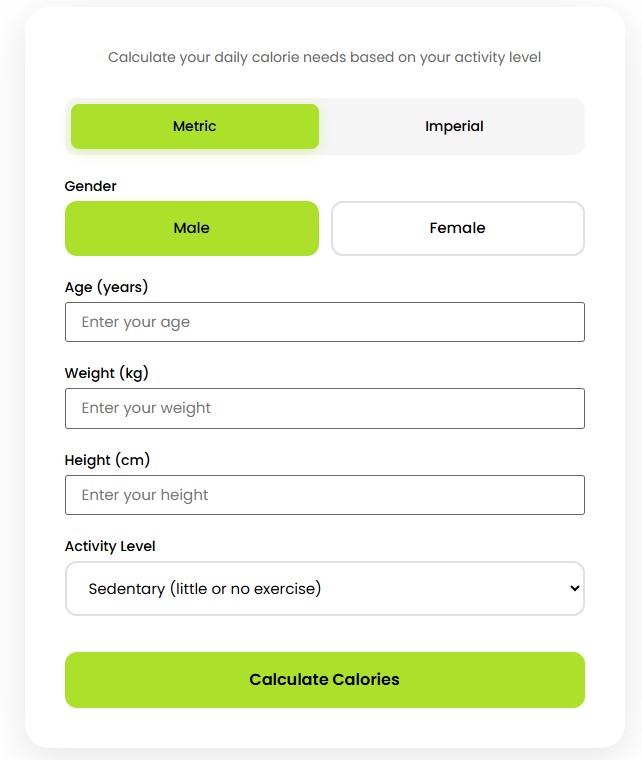
Calculate your daily calorie needs based on your activity level
Trying to lose weight, gain muscle, or maintain your current size? Knowing how many calories you need each day is the foundation of any successful nutrition plan. Our calorie calculator helps you find your personalized daily calorie target based on your body measurements and lifestyle. This tool is perfect for anyone who wants to take control of their diet and reach their health goals. Whether you are an athlete tracking performance, someone managing their weight, or just curious about your energy needs, this calculator gives you accurate numbers in seconds. You enter basic information like your gender, age, weight, height, and activity level. The calculator then shows you how many calories your body burns each day just to maintain its current weight. You can use this number to create a calorie deficit for weight loss or a surplus for muscle gain.
The calculator starts by collecting essential details about your body and lifestyle. First, select your gender because men and women have different metabolic rates due to differences in body composition and hormones. Next, enter your age in years since metabolism typically slows down as you get older. Then input your current weight in kilograms or pounds. After that, provide your height in centimeters or feet and inches. Finally, choose your activity level from the dropdown menu. Options range from sedentary for desk jobs with little exercise to very active for people who exercise intensely most days. Each piece of information helps create a more accurate calculation of your energy needs.
The calculator first determines your Basal Metabolic Rate, which is the number of calories your body burns at complete rest. This represents the energy needed for basic functions like breathing, circulating blood, maintaining body temperature, and cell production. Your BMR accounts for the largest portion of your total daily calorie burn, typically around 60 to 75 percent. The calculator uses proven formulas that consider your gender, age, weight, and height to estimate this baseline number. Men usually have higher BMR than women because they typically have more muscle mass. Younger people have higher BMR than older adults.
After finding your BMR, the calculator multiplies it by an activity factor based on your selected activity level. This gives you your Total Daily Energy Expenditure, which is the total calories you burn in a full day including all activities. A sedentary person might have an activity factor of 1.2, while someone very active could have a factor of 1.9. This final number tells you how many calories you need to eat each day to maintain your current weight. Eat fewer calories than this number and you will lose weight. Eat more calories and you will gain weight. The calculator may also show you calorie targets for different goals like losing one or two pounds per week.
This is the most widely used and accurate formula for calculating Basal Metabolic Rate in men. You multiply your weight in kilograms by 10, multiply your height in centimeters by 6.25, and multiply your age by 5. Add the weight and height values together, subtract the age value, then add 5. The result is your BMR in calories per day.
The formula for women is almost identical except it subtracts 161 instead of adding 5. This accounts for the generally lower metabolic rate in women due to differences in body composition. Women typically have higher body fat percentages and lower muscle mass than men of similar size.
Multiply your BMR by the appropriate activity factor to get your total daily calorie needs. This accounts for all the energy you use throughout the day beyond just resting metabolism.
Let me show you how this works with a real example. Suppose you are a 30 year old male who weighs 80 kilograms, stands 180 centimeters tall, and has a moderately active lifestyle.
First, calculate your BMR using the male formula. Multiply 80 by 10 to get 800. Multiply 180 by 6.25 to get 1125. Multiply 30 by 5 to get 150.
Now add 800 plus 1125 to get 1925. Subtract 150 to get 1775. Add 5 to get 1780.
Your BMR is 1780 calories per day. This is what your body burns just to stay alive at rest.
Next, apply your activity factor. Since you are moderately active, multiply 1780 by 1.55.
This gives you 2759 calories per day as your TDEE.
This means you burn approximately 2760 calories each day with your current activity level. To maintain your weight, eat about 2760 calories daily. To lose one pound per week, which requires a 500 calorie daily deficit, eat around 2260 calories per day. To gain muscle, eat around 3000 to 3200 calories daily with proper strength training.
If the same person was sedentary instead of moderately active, their TDEE would be 1780 times 1.2, which equals 2136 calories. That is a difference of over 600 calories per day just from activity level.
Calorie calculators provide good estimates but are not perfectly accurate for everyone. Individual metabolism can vary by 10 to 20 percent due to factors like genetics, hormone levels, and body composition. The calculator gives you a starting point. Track your weight for a few weeks while eating at your calculated calorie level. If you are not seeing expected results, adjust your intake by 100 to 200 calories and monitor again.
Most people find success eating roughly the same calories each day for consistency. However, some prefer calorie cycling where they eat more on workout days and less on rest days. As long as your weekly average matches your goal, both approaches work. The most important factor is finding a pattern you can stick with long term.
A safe and sustainable rate is losing one to two pounds per week. This requires a daily calorie deficit of 500 to 1000 calories below your TDEE. However, you should not eat below 1500 calories for men or 1200 calories for women without medical supervision. Extreme calorie restriction can slow your metabolism and cause muscle loss. Moderate deficits work better for lasting results.
Counting calories is not necessary for everyone. Many people maintain healthy weights by eating whole foods, watching portion sizes, and staying active. However, tracking calories can be very helpful when you have specific fitness goals, struggle with portion control, or want to understand your eating patterns better. Use calorie counting as a tool when it helps, not as a permanent obsession.
Once you know your daily calorie needs, the next step is understanding your body composition. Our Body Fat Calculator helps you estimate what percentage of your weight comes from fat versus lean tissue like muscle and bone. This information is valuable because two people can weigh the same but have very different body compositions and health risks. Body fat percentage is often a better indicator of fitness than weight alone. Visit the Body Fat Calculator at https://calcversa.com/body-fat-calculator/ to get a complete picture of your physical health and track your progress beyond just the number on the scale.