Interest Calculator
?
Results
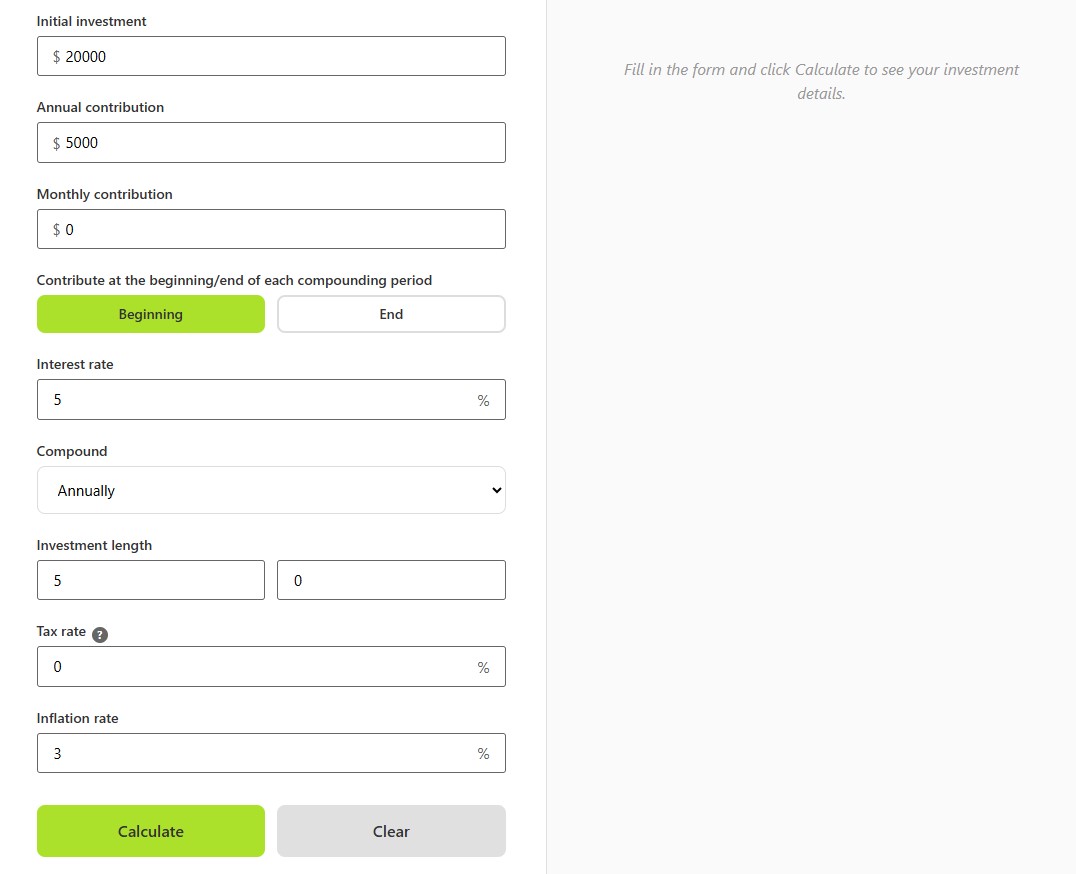
Fill in the form and click Calculate to see your investment details.

Welcome to the Interest Calculator on CalcVersa — a free online tool that helps you calculate total interest, final investment value, and compare simple vs compound interest growth.
Whether you’re calculating loan interest, investment returns, or savings growth, this calculator helps you understand exactly how interest impacts your money over time.
Start using the calculator below or explore more powerful financial tools on the CalcVersa.
Our interest rate calculator helps you:
This tool works for:
If you’re calculating monthly loan payments specifically, try our dedicated Loan Calculator on CalcVersa
Understanding the difference between simple and compound interest is essential when calculating returns or borrowing costs.
Simple interest is calculated only on the original principal amount.
Formula:
SI = P × R × T
Where:
P = Principal amount
R = Annual interest rate
T = Time in years
Example:
If you invest $5,000 at 6% for 3 years:
Interest = 5000 × 0.06 × 3 = $900
Final amount = $5,900
Compound interest is calculated on both the principal and accumulated interest.
Formula:
CI = P × (1 + r/n)^(n×t) − P
Where:
P = Principal
r = Annual interest rate
n = Compounding frequency per year
t = Time in years
Example:
$10,000 invested at 5% compounded annually for 4 years grows to approximately $12,155.
Compound interest grows faster because interest earns interest over time.
Using this free interest calculator is simple:
You can adjust values to compare scenarios and understand how rate or time changes affect your results.
Real examples help illustrate how interest works.
Example 1 – Simple Interest
Principal: $8,000
Rate: 4%
Time: 5 years
Interest earned = $1,600
Final amount = $9,600
Example 2 – Compound Interest
Principal: $15,000
Rate: 7%
Time: 6 years
Compounded annually
Final amount ≈ $22,506
These examples show how powerful compounding can be over longer time periods.
Interest affects both borrowing and saving decisions.
When borrowing:
Higher interest rates increase total repayment cost.
When investing:
Higher rates accelerate wealth growth, especially with compound interest.
Understanding interest helps you:
To calculate loan-specific interest and monthly payments, use the Loan Calculator on CalcVersa.
For long-term wealth growth projections, explore other financial calculators available on the CalcVersa website.
Even a 1% difference in interest rate can significantly impact total returns or loan costs over time.
For example:
$20,000 invested at 5% for 10 years ≈ $32,577
$20,000 invested at 6% for 10 years ≈ $35,817
That small difference results in over $3,000 additional growth.
This is why comparing rates carefully is essential before committing to loans or investments.
An interest calculator is an online tool used to compute total interest earned or paid based on principal, rate, and time.
You can calculate simple interest using the formula P × R × T. Compound interest uses P × (1 + r/n)^(n×t).
Simple interest is calculated only on the principal. Compound interest is calculated on both the principal and accumulated interest
Yes. This tool can estimate loan interest, but for full monthly repayment breakdowns, use our Loan Calculator.
Because interest earns additional interest over time, creating exponential growth.
CalcVersa provides easy-to-use online calculators designed to help users make informed financial decisions.
Explore additional tools like the Loan Calculator and other financial planning calculators on the CalcVersa.
Disclaimer: This calculator provides estimates for general information only and does not constitute financial advice. Please consult a qualified financial advisor before making financial decisions.
© 2026 CalcVersa. All rights reserved.